Maybe an overgrown utility right-of-way needs attention. Maybe you’re preparing a property for construction. Or maybe trees and brush have taken over an area that’s supposed to be accessible.
Whatever the reason, you’ve got vegetation standing between you and what needs to happen next.
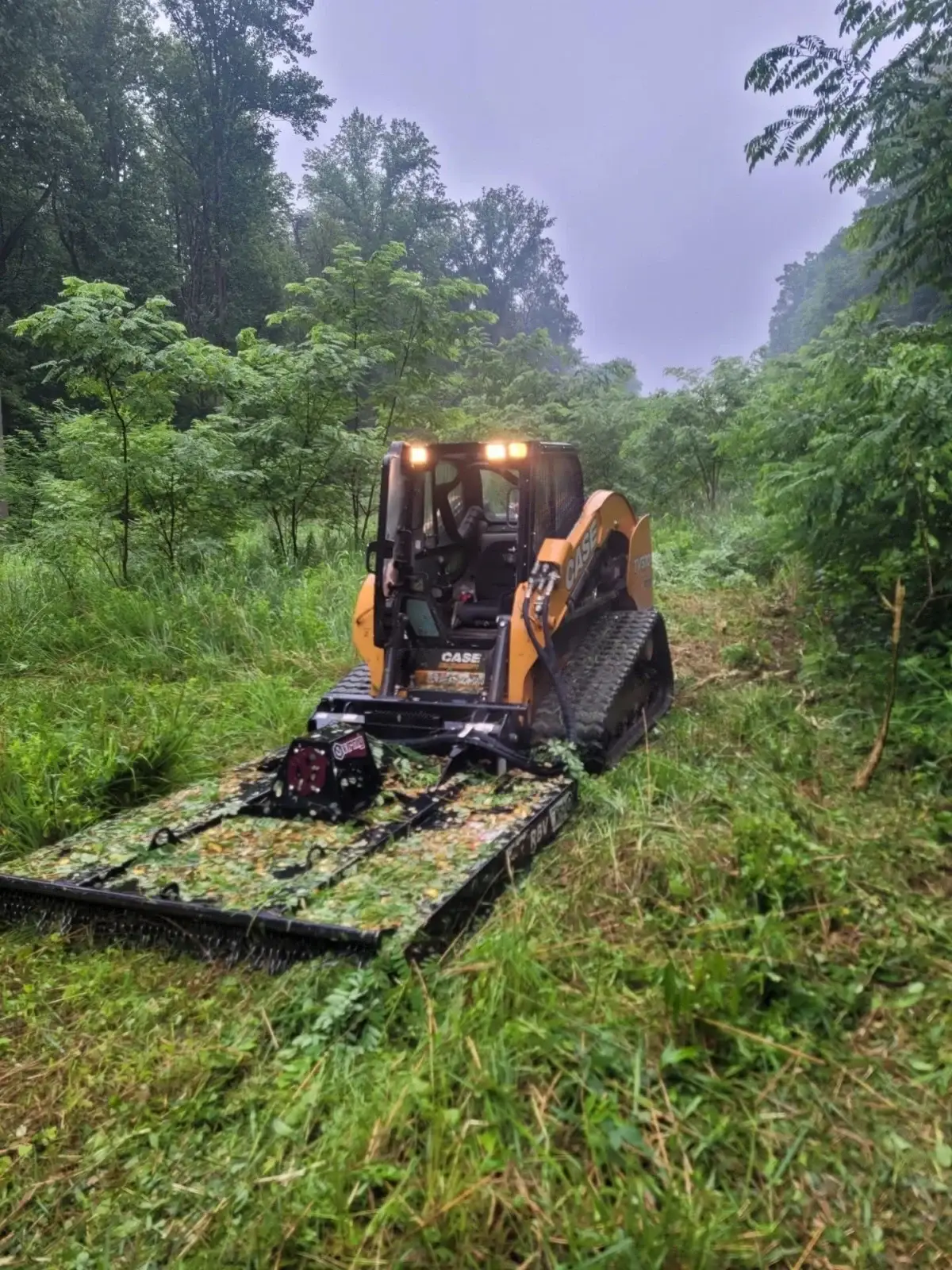
At North Country Unlimited, we provide land clearing and right-of-way clearing services throughout Central Pennsylvania, helping utility companies, contractors, and property owners clear unwanted vegetation.
From recurring utility corridor maintenance to smaller commercial land clearing projects, we bring the equipment, crews, and flexibility to handle different types of clearing work.
Tell us what you’re trying to accomplish. We’ll take a look at the property and discuss how we can help.
Not every utility company maintains its rights-of-way the same way.
Some schedule vegetation maintenance every few years to keep brush and trees under control. Others wait longer, leaving more extensive clearing work when the time comes.
North Country provides right-of-way clearing and vegetation maintenance for utility customers, including work along gas pipeline corridors.
Whether we’re returning to an established corridor or clearing one that’s become heavily overgrown, we work within the utility’s requirements for access and clearing boundaries.
We’ve worked on utility projects involving long stretches of right-of-way, with clearing widths and requirements determined by the utility company.
Our right-of-way maintenance capabilities include:
One utility might call for clearing a 40-foot-wide corridor. Another might only need a 10-foot section maintained.
Those boundaries matter, as do the utility’s rules for property access and working around existing infrastructure.
We plan our clearing work around those requirements and the conditions we encounter along the way.
And while we handle initial clearing when needed, ongoing right-of-way maintenance is an important part of the work we do and a service we’re continuing to develop.
Not every clearing project involves a utility line.
Sometimes a property needs to be opened up for construction. Sometimes overgrown trees and brush are blocking visibility. And sometimes a landowner simply wants to make an area usable again.
North Country provides commercial land clearing, brush clearing, and lot clearing services for projects throughout Central Pennsylvania.
Depending on the property and the intended use, that may include:
For example, we recently completed a clearing project for Lamar Advertising, removing trees and vegetation to improve visibility for a new billboard.
Because the work was along a busy road, our tree crew had to carefully remove certain trees rather than simply dropping them.
That’s a good example of how even a relatively straightforward clearing job can require more than one approach.
We’re particularly well suited to smaller and mid-sized clearing projects, although we’re always willing to discuss larger assignments and determine whether they’re a good fit.
On paper, clearing a right-of-way might sound simple.
Drive through with a brush hog. Cut everything back. Move on to the next section.
But then you reach a steep hillside. Or a marshy area. Or a stretch of ground that’s too wet to support the equipment.
Now the job looks a little different.
North Country uses brush hogs and other clearing equipment, bringing in larger machinery when the project calls for it.
But some locations aren’t suitable for equipment at all.
We’ve worked on retention ponds and mountain properties where the terrain or access limitations required crews to clear vegetation by hand.
Sometimes the biggest obstacle isn’t the vegetation. It’s getting to it.
Steep slopes, wet ground, and limited access can all change how a clearing job needs to be handled.
And what looks manageable on Monday might be a muddy mess by Thursday.
Sometimes removing the vegetation is the whole job.
Other times, it’s just the beginning.
An overgrown property may also need grading, excavation, or other improvements before it can serve its intended purpose.
That’s where North Country’s broader site capabilities can come into play.
One example is our work restoring overgrown stormwater retention ponds.
We’ve encountered ponds so neglected that trees and brush had effectively turned them into wooded areas.
On one such project, our first challenge was figuring out how to access the pond at all.
The initial phase involved clearing the vegetation down to grade. The next planned phase includes dredging the pond, rebuilding access ramps, and creating a route into the area for future work.
It’s a good illustration of how clearing can be part of a larger site improvement project.
An overgrown utility corridor. A lot that needs to be cleared for construction. A property that’s become difficult to access or maintain.
Every site is a little different, and so is the work required to clear it.
Tell us what you’re dealing with, where the property is located, and what you’re trying to accomplish.
We’ll take a look and discuss the best way to move forward.